
Small in number but mighty in mission, the American Health Care Association’s (AHCA) intellectual and developmental disability (ID/DD) care providers are in many ways superheroes for those they serve. Their role comes with great responsibility. Their clients are vulnerable children, adults, and elderly individuals with complex medical and behavioral health conditions. Many of them require care interventions several times a day. But severity of their clients’ conditions doesn’t hold them back. Operating amid steep Medicaid cuts and workforce shortage challenges, ID/DD providers, with their laser focus on providing comprehensive care, do all in their power to ensure that their clients live the most autonomous and fulfilling life possible
Letting Kids be Kids
 Cedarcrest, based in Keene, NH, is a specialized pediatric medical facility and school caring for children with complex medical and developmental needs from infants through age 22. It is the only facility of its kind in the state and about 40 percent of children rely on a ventilator.
Cedarcrest is all about addressing medical needs so that the kids can be kids. “The most important value for us is that we don't want a child to worry about their ventilator,” says Jay Hayston, president and chief executive officer (CEO). “We want them to worry about their project that they're working on for school, seeing their friends, or getting out to a birthday party.”
How It Works
Powered by a dedicated staff, children are in school from 8:30-2:30pm, with elementary, middle, and high school classrooms on site. Afterwards, children enjoy downtime with a little fun. Be it listening to Taylor Swift’s latest song, or doing quiet activities of choice, kids transition into an evening care routine for relaxation.
Amid terminal diagnoses, complicated need profiles, and other realities, children enjoy a weekly field trip out in the community. “There are heavy circumstances in our building, but the air is never heavy here,” says Hayston. “The feeling of our work is joyous.”
Resident Goals
Learning about resident goals and helping them succeed is a part of the mission at Billings Fairchild Care Center, located in Billings, OK. Billings cares for residents age 18-86, operating four intermediate care facilities (ICF).
Consuela Dolezal, administrator at Billings Care Center in Enid, Oka., loves watching people learn new things, which happens a lot at Billings.
Dolezal will sit down with a client to ask what their overall goal is. “We talk about what we need to learn to obtain that goal,” says Dolezal. “If its money management, it could be showing them how to write a check or pay a bill online.”
One client told Dolezal he wanted to get a job as a waiter. Staff set up a mock station where the resident could role play. That included learning the abbreviations of items via YouTube, taking an order of another client, and bringing the items on a tray.
Active Treatment
“The crux of everything that we do is active treatment, says Dolezal. “That's helping to promote the client's individual independence, helping them to find that autonomy that they deserve, and that sense of accomplishment.”
|
|
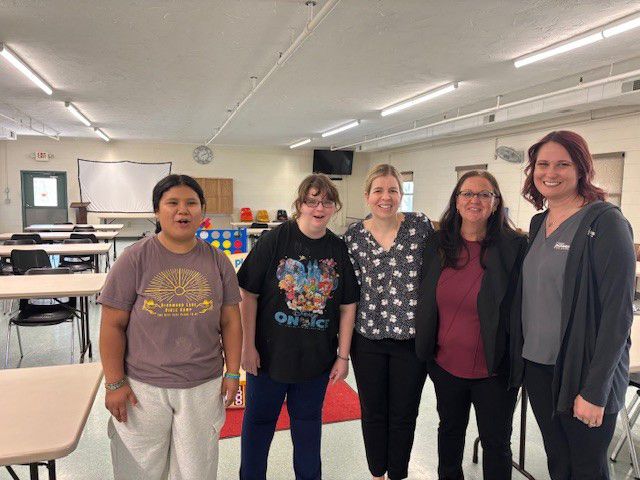
From left, Jasmine and Cynthia, residents of Billings Care
Center; AHCA’s Dana Ritchie; Dolezal; and Natashia Mason from the Oklahoma Association of Health Care Providers. |
In a recent tour with representatives of Care Providers Oklahoma and AHCA, Dolezal invited residents to give the tour, and they did, with flying colors. They gave participants insight into what Billings does and introduced them to staff and other residents.
Stages and Settings
Supporting individuals with ID/DD often spans through life in different stages and settings.
Jaime Anthony is chair of the AHCA ID/DD Committee and executive director at Developmental Options, a private nonprofit corporation operating ICFs in Southeast Idaho.
Client age ranges from seven to 67. The door to entry can be a parent who is in crisis, trying to locate care for their child, or a parent who needs help caring for their child because they are aging.
Individuals may start out in an ICF setting, but as they age and learn skills, they may advance into their own apartment, receiving support. Here they may be working and have independence, and as they get older, they may need home health hospice.
“It progresses as that person ages through every part of their life, and we’re providing those supports so that they can be successful,” she says.
Common Challenges, Different Story
In Oklahoma, 37 of the ICFs operating in the state are members of Care Providers Oklahoma. Steven Buck, president and CEO and father of an ICF resident, says that because ICFs are often put into the same category with nursing homes via state and federal policy. One challenge is to articulate to lawmakers the differences in payor mix and treatment/care goals.
A viable nursing home community may typically have a payer mix that includes Medicaid, Medicare, etc. In Oklahoma, most ICF communities are 100 percent Medicaid funded, including Billings. Because of the state’s reimbursement methodology, ICF reimbursements are based on a rate with a two-year lag in inflation adjustments and lack the ability to diversify their revenue to keep up.
“A robust Medicaid rate is essential to the success of ICF communities,” says Buck. The One Big Beautiful Bill Act (H.R.1) brings additional pressures. “In Medicaid expansion states like Oklahoma where we wrestle with the new realities of H.R.1 and the pressure on state budgets that it will bring, it is imperative that these communities receive payment consistent with their cost of care.”
Always a Reason
Hayston credits New Hampshire’s federal delegation for their support of the profession, but as multiple priorities compete for Congressional attention, it’s easy for a niche or acute service priority to slip through the awareness cracks.
“It's making sure that legislators are aware that it is a responsible fiscal choice to support and empower providers like us,” says Hayston.
An example of this comes down to dollars and cents. If not for Cedarcrest, the constellation of needs a resident has would require a specialty bed at the local children's hospital, which would cost many times more.
The Utah Experience
Currently seven members of the Utah Healthcare Association (UHCA) are ID/DD providers. As part of their membership, they serve on an ID/DD committee, and one member also serves on the board of directors.
Allison Spanger, president and CEO of UHCA, says ID/DD care awareness is crucial to ensuring that individuals with ID/DD not only get the medical care they need, but the social and community support as well. “Many residents living in ID/DD communities have jobs or they go to vocational rehab to help build their personal skills according to the goals that they’ve made with their care staff and clinicians,” says Spangler.
“Without these providers, I think that there would be much bigger problems for not just Utah, but around the country and for the cost of care as it relates to the appropriate setting for these types of patients.”
Challenges and Opportunities
One measure that has helped is the Utah Quality Incentive Program, a federal and state funded program that incentivizes providers. Specifically, they may submit proposals for improvement projects such as dining enhancements or additional vehicles for transportation. Another way to apply for funding is to demonstrate quality outcomes to meet a performance incentive.
“This program really has been a blessing to providers because they've been able to do things that they normally wouldn't have because of their funding,” says Spangler.
Opportunities like the annual AHCA ID/DD Fly In offer providers a chance to raise awareness directly with Congressional members and staff and learn the latest policy developments from Capitol Hill.
This year, Spangler attended with a diverse group of ID/DD providers and state association executives. She surprised her eleven-year-old daughter by taking her along for the event, where she learned about the ID/DD profession and what advocacy means on Capitol Hill.
“It was a good opportunity for her to see the vital role that ID/DD care facilities play and also how she can use her own voice,” says Spangler. “She'll be a voter one day. She'll be employed. I think that's important for anyone to understand how important their voice is.”
Working on Workforce Challenges
When it comes to workforce challenges, Anthony points out her team’s revamp of their approach post-COVID, when already existing workforce shortages were exacerbated. The first area of focus was ensuring that the ICF Medicaid reimbursement rate allowed facilities to be competitive in their wages, an area where progress has been made. The team also reevaluated the training curriculum to help ensure that it was preparing staff who have different profiles to be successful in the role.
“This is a college town, so you may get staff from the university. Other staff are here because this is the career they want,” says Anthony. “We look at all these things, including retirement. At the same time, we ensure that we are being clear on the demands of the role, because it is a challenging job.”
Why Can’t We?
Amid the advocacy in states and on Capitol Hill, the superhero strength of ID/DD care providers can be seen in the stories of clients who, amid a full schedule of care and education, are also realizing their dreams.
A few years ago, Hayston was in the high school classroom when one of the young men used his communication device to tell him that he wanted to see penguins. Hayston asked what he meant. The child explained that he had never been to an aquarium before and he always wanted to see penguins in person. He also shared that, because he was on a ventilator, he understood that this wasn’t an easy thing to do.
“I pulled the teacher aside and said, ‘We’re going to figure out how to do this,’” says Hayston. What followed was planning and coordination on how to get multiple ventilators, nurses, and vans to carry it all two hours away in Boston. The staff made it happen, and it’s a memory that continues to inspire.
“I have the best job in the world,” says Hayston. “I get to ask a question, ‘Why can't we? Why can't we bring him to meet the penguins?’”
| If you would like to learn more about AHCA’s ID/DD care providers and committee and ways to get involved, please contact AHCA’s Associate Vice President of Workforce & Constituency Services, Dana Ritchie, at
dritchie@ahca.org. |
Amy Mendoza is a freelance writer and editor specializing in long term care, health policy, and health care operations.
Provider magazine includes information from a variety of sources, such as contributing experts. The views expressed by external contributors do not necessarily reflect the views of Provider magazine and AHCA/NCAL. Learn how to submit an article.