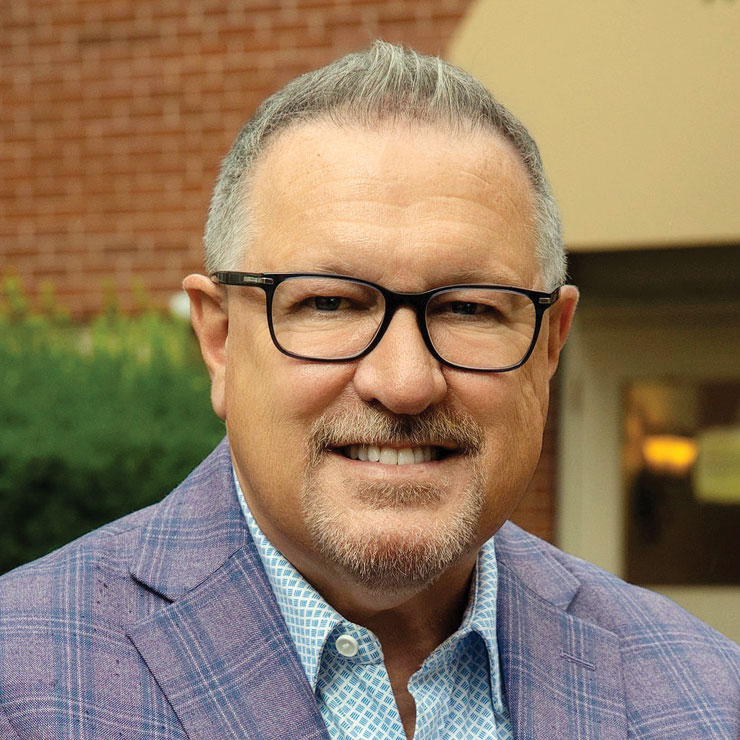
 Chris Wright has worn multiple hats in long term care, including certified public accountant (CPA), vice president, entrepreneur, board member, lifetime achievement award recipient, and son of a skilled nursing resident. But he sees his ultimate role as servant. Today, he is chair of the American Health Care Association (AHCA) board of governors, setting the national policy agenda for long term and post-acute care and serving care providers nationwide.
Wright credits certain basics for sustaining him: faith, family, and humility, to name a few. What makes him an authority is his ability to keep the lessons he’s learned front and center while leading others to reach new goals and results.
His desire to advocate for the long term care profession was inspired by those who expanded his appreciation early on. “My mother had a stroke in her seventies, and she was in a nursing home for eight years, and before she passed away, I learned a whole different perspective, being on the family side. I became very appreciative of the unsung heroes in the facility.
“That experience made me want to advocate even more for our residents, for my mom and the staff.”
A Numerical Start
Wright’s career started in numbers. After earning a bachelor’s degree in accounting from Lenoir-Rhyne University in Hickory, N.C., he went to work at a CPA firm. At 25, he landed his first role at a Southeast regional nursing home chain in North Carolina, working in the finance department. Eventually, he was promoted to the operations wing as vice president of budgeting and planning.
“I worked directly with the vice president of operations, and I would be the numbers guy,” Wright said. He gained firsthand knowledge of how nursing homes worked through his many trips to the chain’s more than fifty communities, assisting administrators while he performed profit and loss reviews, managed accounts payable, and oversaw the preparation of all the nursing home budgets. The organization also had ancillary companies, including those covering therapy, pharmacy, and medical supplies.
The ‘Right’ Personality
Here, Wright said, is when he fell in love with the profession. “You know, as a CPA, you’re not expected to have an outward personality, but I was told I did have that personality. It was then that I realized the importance of the work we were doing and that there were people behind the numbers. That led me into this very challenging but rewarding industry.”
Wright realized what he was getting into. “This is not a very glorified industry,” he said. “You have to be mission driven, and you have to want to serve and help people with their quality of life as they get older.”
 After serving in the “numbers guy” role for eight years, Wright moved on to do CPA consulting work for skilled nursing clients in the Denver area. His practice expanded to operational strategies, reimbursement, and, eventually, management and ownership. It was then that his company bid on facilities in Connecticut and purchased them out of receivership. Wright moved back to the East Coast to run the newly created iCare Management, now iCare Health Network, in Manchester, Conn.
Right away, Wright welcomed a turnaround challenge. “Our model at the beginning was to buy underperforming facilities,” he explained. “Of the twelve buildings we have today, nine were purchased out of receivership. We built those up to increase the value and quality of care.
“We own all the assets, management operations, and the real estate, which I think is a very good model. When you can manage all the challenges, that goes a long way in this environment.”
iCare Health Network delivers comprehensive short term rehabilitation and long term care services across its continuum of skilled nursing centers. While iCare serves a traditional nursing home population in many locations, it specializes in caring for individuals with complex medical, behavioral, and social challenges who are often underserved in traditional settings.
iCare centers offer extensive programming in behavioral health, substance use disorders, memory care, and justice-involved care. In Connecticut, each iCare center features at least one specialized clinical program. These range from advanced management of refractory heart failure and chronic pulmonary disease to on-site dialysis services and dedicated care pathways and programs for individuals living with HIV, Huntington’s disease, limb loss, and other complex conditions. The organization also provides specialized services for veterans and other high-acuity populations.
Many of the individuals iCare serves have experienced housing instability, substance use disorders, justice involvement, and other stigmatizing barriers to care. iCare’s unique model is part of Wright’s desire to be a problem solver.
“From the beginning, iCare has chosen to lean into complexity and challenge rather than away from it,” said Wright. “Our care centers and programs are designed to serve individuals who are too often overlooked or underserved—those with challenging medical conditions, behavioral health needs, or complicated social circumstances—and to do so with clinical skill and in a stigma-free manner. That commitment to meeting underserved populations where they are is what distinguishes iCare within the post-acute landscape and is a point of pride.”
A Dual Approach
Wright credits iCare’s success to having a great team and bringing in people with fresh ideas to help run the day-to-day business. This allows the company to stick to its mission of caring for residents who may be difficult to place in other settings.
When it comes to balancing providers’ everyday realities with a long-term vision, Wright said a dual approach is required.
“You have to realize there are nonnegotiables that we must deal with. For example, if staffing is an issue, you’ve got to be very deliberate and manage it. You need to figure out a way to stabilize it and to pull it together. That is nonnegotiable.
“At the same time, even though people have a business to run, they also need to get involved and advocate, especially with the state associations. We know what the challenges are. It can be a hard thing to balance, but you have to stay involved and be deliberate and intentional on what you have to deal with,” he said.
Transitioning Leadership
Recently, Wright made his own leadership transition. In 2025, he stepped out of the position of CEO of iCare, brought on a new CEO, and took on a new role in the company as chairman.
“It gives me the opportunity to step back and focus on our growth,” he explained. “I look at what we do well and take from my experiences to focus on how we can continue our mission.”
Stepping into AHCA
 Wright embarked on another path when he joined the AHCA board of governors in 2018. At this juncture, advocacy became front and center.
“This was a pivotal point and life-changing for me. It was to move to the next step—taking my experiences of the last four decades and using them to advocate for residents and a staff at a national level.”
The next change came last year when he was elected chair of the AHCA board. In this new role, Wright said, remembering his own beginnings has factored into his mindset.
“I look at it as a servant position. I’m not here to exert control. It’s about serving our members, and I’m focused on unifying a lot of priorities that we need to advocate for.”
Goals as AHCA Chair
As chair, Wright sees support of state affiliates and continued collaboration with the Centers for Medicare & Medicaid Services as central to keeping progress moving. Advocating for changes to the Five-Star Quality Rating System tops his priorities list as part of the association’s push to rationalize the oversight system.
“The Five-Star system is too confusing to consumers, and it changes all the time,” he said. “We’re all for transparency and accountability, but give us a system that truly rates facilities consistently, fairly, and in a timely fashion.”
Another priority has to do with reimbursement. While Wright highlights the sector’s victory last year in avoiding Medicaid cuts in the One Big Beautiful Bill Act, he pointed out the challenges individual states will have in figuring out how to manage the larger changes to the program due to the bill. With the federal share likely to shrink, Wright said, American Health Care Association/National Center for Assisted Living state affiliates will play a key role in navigating potential Medicaid cuts in their states to protect nursing homes as Congress intended.
Wright also pointed to improvements needed in Medicare Advantage plans, a key part of the AHCA Better Way agenda. For older and sicker populations, the program is challenging, with frequent delays or denials in post-acute care and prior-authorization requests.
“It’s frustrating, and my parents were on the program],” he said. “We want Medicare Advantage to do the right thing for the beneficiaries and deliver on its promise.”
Keeping the Path and People in Mind
With a full agenda ahead of him, Wright recalled his journey to this point. “I am very humbled, and I know how I got to where I am,” he said. “It wasn’t given to me on a silver platter. I paid for my own college education, for instance. I wasn’t handed a company and told, ‘Here, take it from here.’”
The numbers guy has come full circle, taking it from here.
Amy Mendoza is a freelance writer and editor specializing in long term care, health policy, and health care operations.