ADVERTORIAL
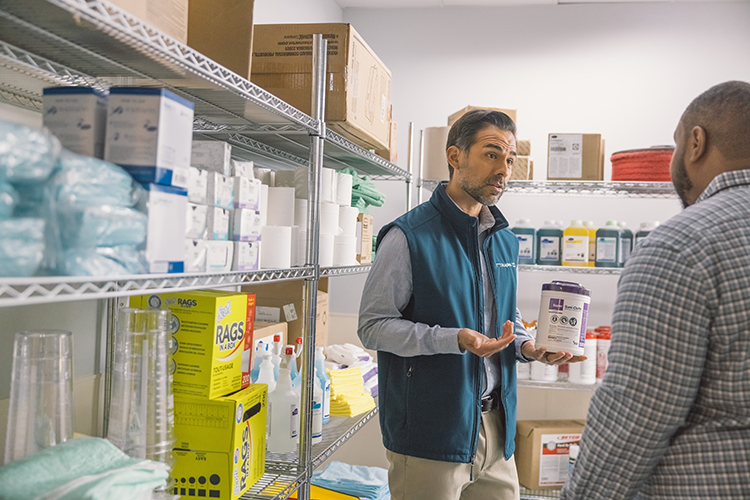
For long term care and senior living providers, regulatory expectations continue to intensify. Infection prevention standards are more prescriptive, environmental services practices receive heightened scrutiny, and surveyors increasingly assess whether processes are executed consistently across units, shifts, and facilities.
Amid staffing shortages and rising costs, many organizations struggle to maintain that consistency. One often overlooked factor is how housekeeping and environmental services (EVS) supplies are selected, managed, and used.
Housekeeping standardization offers a practical way to strengthen survey readiness. By aligning products, purchasing, and workflows across facilities, operators can reduce variation, support staff training, and create more defensible, repeatable practices during survey.
Why Variation Creates Compliance Risk
Surveyors not only assess whether appropriate supplies are available, but whether staff consistently understand how and when to use them. When multiple brands, formats, or SKUs are in circulation, training becomes more complicated and execution less reliable.
“When staff know exactly what to use and how to use it, execution becomes more consistent and errors decline,” says Greg Hemmer, a health care facilities solutions expert with Staples Business.
From a regulatory perspective, standardization reduces the likelihood of improper product use, dilution errors, or substitution during supply shortages. It also supports clearer documentation and consistent protocols, both of which can be critical during survey review.
Gaining Visibility Across Facilities
Another regulatory challenge for multi-site operators is limited visibility into purchasing practices. Without centralized oversight, leadership may struggle to confirm whether approved products are being used or if individual facilities are introducing unapproved alternatives.
That was the case for Claiborne Senior Living, which owns and operates 17 senior living communities across the Southeast. Each property had historically purchased its own housekeeping and environmental services supplies from various vendors.
“We needed a clearer picture of what each community was spending and what they were actually buying,” says Molly Crawford, asset manager for Claiborne Senior Living. “Not just from a cost standpoint, but for consistency.”
Working through its group purchasing organization, HPSI Purchasing Services, Claiborne explored opportunities to standardize purchasing across facilities. Certain vendor partners, including Staples, were identified as resources that could support consistent product selection, site-level quantities, and consolidated reporting.
Aligning Supplies with Regulatory Expectations
Like many long term care leaders, Crawford initially associated Staples primarily with office supplies. What she learned was that Staples supports health care providers across categories including housekeeping, dispensers, furniture, technology, and print, and maintains relationships with major GPOs serving the sector.
Staples analyzed Claiborne’s historical purchasing data and identified opportunities to reduce variation, consolidate SKUs, and align products across communities. The immediate financial impact was clear.
“It was an automatic 17 percent savings,” Crawford says. “Across 17 buildings, that’s significant. Small costs really do add up.”
Equally important, leadership gained confidence that every community had access to the same approved products, helping reduce compliance risk when surveyors assess practices across locations or revisit findings.
Ensuring Availability Without Disruption
Standardization must be paired with reliable access to supplies. Delays or substitutions can disrupt care and undermine compliance, particularly during peak demand or severe weather events.
“Timing is critical,” Crawford says. “Our business doesn’t stop. We can’t wait days for critical supplies.”
To minimize risk, Claiborne piloted standardized products at one community before expanding systemwide. The gradual rollout gave teams time to validate product performance, confirm staff adoption, and ensure delivery timelines aligned with operational needs.
Over time, Claiborne standardized key environmental services components, including towel, tissue, and soap dispensers, as well as gloves, trash liners, wipes, microfiber cloths, and other housekeeping essentials. Using fewer brands and consistent SKUs reduced substitution risk and simplified oversight.
Simplifying Training and Reinforcing Execution
One of the most tangible compliance benefits of standardization has been its effect on staff training. When products are consistent, onboarding becomes less complex, and procedures can be reinforced uniformly across communities.
“When we implement change, we focus on sustainability,” Crawford says. “Success isn’t tied to any one person. Standardization creates consistency and makes training easier across our communities.”
This consistency helps staff confidently explain processes during survey, supports more uniform execution across shifts, and reduces variation that could otherwise prompt surveyor concern.
Reducing Administrative Burden on On-Site Leaders
Before standardization, on-site leaders spent time researching products, comparing prices, managing vendors, and reconciling invoices, time that could be spent supporting staff or maintaining regulatory readiness.
“That’s the hidden labor cost,” Hemmer explains. “Time spent scouring the internet for products instead of focusing on the community.”
By consolidating purchasing on a single platform, Claiborne reduced administrative tasks for department heads and simplified budgeting. Managers no longer needed to make product decisions or manage multiple suppliers.
“All they have to worry about is staying within their budget,” Crawford says.
Building a More Survey-Resilient Organization
Today, Claiborne has clearer visibility into spending, product usage, and cash flow across all 17 communities. That visibility helps leadership identify risks, reinforce standard practices, and plan with greater confidence.
“Because we know our average spend and manage it consistently,” Crawford says, “we’re better able to spot inefficiencies, reduce risk, and make informed decisions as we grow.”
For long term care providers navigating evolving regulatory expectations, housekeeping standardization is not simply an efficiency initiative. It is a foundational strategy that supports infection prevention, staff execution, training, and survey readiness, while also reducing complexity and controlling costs.
To learn more about how standardized purchasing supports regulatory readiness and operational consistency in senior living and long term care, contact Greg Hemmer at Gregory.Hemmer@Staples.com or visit staplesbusiness.com/seniorliving.
Provider magazine includes information from a variety of sources, such as contributing experts. The views expressed by external contributors do not necessarily reflect the views of Provider magazine and AHCA/NCAL. Learn how to submit an article.