 Fall is in full swing, which means providers are once again facing a set of unwelcome visitors: the flu, COVID-19, and respiratory syncytial virus (RSV). These viruses are especially prevalent in the autumn and winter months, and they pose the greatest risk to older adults, young children, and those living with chronic conditions. Fortunately, vaccines are still a safe and effective front line of defense.
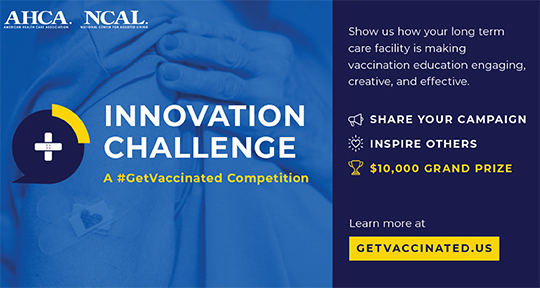
In September 2026, the American Health Care Association/National Center for Assisted Living (AHCA/NCAL) launched its 2026-2027 #GetVaccinated campaign, which gives providers the tools they need to successfully implement vaccination protocols during the respiratory virus season. With support from Moderna, this season’s #GetVaccinated campaign includes the new Innovation Challenge, a competition that invites members to show off their creative vaccination efforts. The organization with the most innovative campaign will receive a grand prize of $10,000 and will be invited to present its campaign during AHCA/NCAL’s Quality Summit in May 2027.
An Effective Tool
#GetVaccinated places a wealth of tools and resources in one convenient hub: GetVaccinated.us, where providers can find everything they need to promote vaccination among their residents and staff. The hub includes fact sheets, links to federal guidance, information about documentation and billing procedures, and a communications tool kit with social media graphics and printable posters.
“Vaccines remain one of our most effective tools for reducing severe illness, hospitalization, and complications from respiratory infections,” Dr. Elizabeth Burns, AHCA/NCAL’s chief medical officer, said in a statement about the #GetVaccinated campaign. “However, vaccine hesitancy continues to be a significant challenge across the country, and long term care is not immune to it.”
That challenge provides an opportunity for providers to share their innovative vaccination strategies with each other. “There is no single solution, but our providers are uniquely positioned to learn from one another in finding practical and creative ways to build trust and boost vaccine uptake,” she said.
Celebrating Each Other’s Creativity
The Innovation Challenge aims to give providers an additional incentive to develop effective vaccination procedures. The competition invites AHCA/NCAL members to submit the strategies and materials they use to educate and build trust among their residents, families, staff, and communities, as well as the results of those strategies. The entries will be judged by a panel of clinical and quality experts who will look for creativity, impact, and campaigns that demonstrably built vaccine confidence.
 Submissions for the Innovation Challenge are due by Feb. 1, 2027, at 5 p.m. EST. The winner will be notified in March and will receive a prize of $10,000, courtesy of a grant from Moderna, as well as an invitation to present the campaign at the AHCA/NCAL Quality Summit. The summit will be held in Austin, Texas, May 3-5. Eligibility guidelines, submission requirements, judging criteria, and other information are available at GetVaccinated.us.
“Long term care providers are doing groundbreaking work every day to protect the health and well-being of the residents entrusted to their care, and that deserves to be recognized,” said Clif Porter, president and CEO of AHCA/NCAL, in a statement about #GetVaccinated and the Innovation Challenge. “Through #GetVaccinated, we’re giving providers practical tools to support their vaccination efforts while also creating an opportunity to celebrate the innovative ways our members are supporting vaccination uptake.”
The CDC’s Latest Vaccine Guidance
The Centers for Disease Control and Prevention (CDC) released its interim guidance for the 2026-2027 flu season in early September. The guidance confirmed that the recommendations made in the July 2025 immunization schedule are still in effect. The CDC continues to recommend routine annual flu vaccination, especially for those with higher risk of influenza complications and the people who live with or care for them. For those ages 65 and over, the CDC recommends a high-dose recombinant or adjuvanted vaccine. The ideal vaccination time frame is generally in September or October, although vaccination is important as long as the flu is in circulation.
The CDC also released its interim guidancefor the COVID-19 vaccine in September. The agency recommends a 2026-2027 COVID-19 vaccine, which targets the XFG strain of the virus, for all adults ages 18 and over. As for the RSV vaccine, CDC guidance published in February 2026 advises that all adults ages 75 and over receive the vaccine, as well as all adults ages 50 to 74 who are at increased risk of severe outcomes from RSV.
Essential Provider Resources
GetVaccinated.us gathers a variety of materials, including CDC vaccination guidance, that providers can use to design and implement their own vaccine campaigns. The materials are arranged by topic, including best practices and general guidance, billing and reimbursement, communication and promotional materials, and vaccines. These resources range from the general, such as an FAQ unpacking common questions and misconceptions about vaccines, to the specific, such as a Medicare billing guide that walks providers through the process of billing for flu, COVID-19, and RSV vaccines.
The communication and promotional materials provided are especially valuable for messaging. These resources include a detailed list of talking points that help convey the importance of vaccination and other infection-prevention measures, with a convenient Q&A for common press inquiries. Additionally, there are handy PSA videos that providers can present to residents, families, and staff, as well as ready-made social media graphics and printable #GetVaccinated posters in both English and Spanish.
Building Trust through Dialogue
Beyond getting people vaccinated, the goal of #GetVaccinated is to encourage productive, empathetic conversations about vaccines based on transparent and accessible information, which ultimately builds trust between caregivers and residents. Over time, open dialogue will inspire vaccine confidence and raise vaccination rates.
For providers, the Innovation Challenge is a valuable opportunity to share what that dialogue looks like, and Burns hopes to hear from as many AHCA/NCAL members as possible. “I encourage all our members to take note of their vaccination efforts this season and share their experience through the Innovation Challenge competition,” she said.
Steve Manning is a journalist based in New York City.