 Like athletes who chase peak performance, long term care organizations pursue excellence in providing care. Specialized training that enhances skills, builds teamwork, and fills knowledge and competency gaps can help providers get closer to that goal. Ultimately, advanced training can better support residents and improve outcomes.
While such training can take time and money, the return on investment is significant. Cathy Ciolek, PT, DPT, FAPTA, FNAP, consultant and project manager for the American Health Care Association’s National Infection Prevention Forum, said, “It’s more productive and cost-effective to have proactive, preventive measures in place to get and keep staff up to speed on key issues, changes, or new developments that they hadn’t considered. This may be because they are outside of their traditional box or comfort zone.” She added that it is important to demonstrate to both regulators and families how you are committed to making life better for your residents.
Dave Kyllo, vice president of member programs at the American Health Care Association/National Center for Assisted Living (AHCA/NCAL), stated, “From a marketing or referral standpoint, having specially trained gerontological nursing staff and others sets you apart from the competition.”
Boosting Nurses’ Long Term Care Acumen
Nursing teams are the engine that keep long term care communities humming. Many nurses come to this sector trained as professionals but may not have specific knowledge of geriatrics and care for older adults. Seeking to increase knowledge for those working in nursing homes and other senior care settings, AHCA/NCAL, working with its Nebraska affiliate, established Gero Nurse Prep, an online, evidence-based training course designed to prepare registered nurses (RNs) to attain board certification in gerontological nursing by the American Nurses Credentialing Center. It is now open for licensed practical and vocational nurses, as well.
 This is significant, Kyllo said, as licensed practical nurses (LPNs) make up a significant portion of the long term care workforce. “It’s important for all of your nursing staff, including LPNs, to be on the same page with training, and programs like this offer tremendous career ladder opportunities,” he observed.
While nursing education provides skills that are applicable to caring for all populations, Gero Nurse Prep fills gaps that are specific to caring for older adults. Heidi Keeler, PhD, MSN/MBA, RN, is executive director of Continuing Interprofessional Development and Innovation and associate professor at the University of Nebraska Medical Center College of Nursing. She shared, “Depending on the nursing program, nurses may have limited perspective and training when it comes to the care of older adults. We know that whatever the setting, the health care needs of older adults are different, and their acuity is typically higher now than in years past.” She suggested that, as a result, “many nurses aren’t getting the kind of training they may need to be truly effective in caring exclusively for older adults, particularly those in skilled nursing and post-acute care facilities, where the complexity of their health care needs is markedly higher.”
Even when nurses go into the Gero Nurse Prep program with knowledge and experience in the care of older adults, the course is eye-opening. Keeler said, “The first aha moment comes at the very beginning of the course, when they take a comprehensive quiz and see they have more to learn than they realized. In fact, on average, there’s more than a twenty-point difference between that first quiz and one they take at the end of the course.”
Participants then go on to use what they’ve learned to improve care. “One nurse told us about how, after completing one module that addressed the various types of cognitive decline and the difference between delirium, dementia, and depression, she realized that one of her patients who was exhibiting signs of early dementia hadn’t been screened for depression,” Keeler revealed. “She recommended this screening, and the individual was diagnosed with depression and prescribed antidepressants. As a result, his cognition improved.”
 Keeler said that nurses come out of the training more confident in their work and in their ability to speak out when they see something or have a suggestion. “A lot of nurses who go through the course talk about how excited they are to share what they’ve learned with their LPNs and CNAs [certified nurse assistants]. I hear story after story about the real impact nurses are making with their patients using the knowledge they’ve gained,” she said.
The impact of having these trained and certified gero nurses is significant for both the facility and its residents. Kyllo noted, “We have conducted research showing that nursing facilities that have more RNs certified in gerontological nursing have lower rehospitalization rates, fewer survey deficiencies and immediate jeopardy citations, and higher Five-Star ratings.”
Research conducted by the University of Nebraska Medical Center showed that there is also an impact on turnover. Specifically, the study showed that buildings that had Gero Nurse Prep-trained nurses had lower turnover rates for both CNAs and nurses, as well as more stable rates for administrator retention.
Training Ups the Game on Dementia Care
According to the Alzheimer’s Association, approximately 6.9 million people in the United States ages 65 and older are living with dementia, including a large percentage of long term care residents. Memory care is a growing aspect of both skilled nursing and assisted living services, with 18 percent of assisted living communities offering a dementia care unit, wing, or designated floor. Thus, it isn’t surprising that senior living communities and long term care facilities are constantly seeking dementia care training for their teams.
While there are numerous programs addressing dementia care, facilities have common goals for this training, including understanding the disease process, maximizing staff-resident relationships, increasing safety for residents and staff, reducing stress, de-escalating situations, and ensuring appropriate use of medications.
 Occupational therapist and dementia educator Teepa Snow founded Positive Approach to Care®, an organization that provides resources and training in dementia care. Her Snow Approach™ techniques are based on how the brain functions.
“We help people appreciate what happens with typical brains and what happens with brains that are changing,” Snow explained. “We then help them develop methods and skills that have a positive impact on all involved in care. In our trainings, after some didactic teaching, we say, ‘OK, now let’s try some of the skills you’ve learned.’ We encourage people to get up, interact, and gain experience and feedback.”
She added, “Without having learners try out the skills, you could be thinking you’re teaching them the content, but they may not be fully understanding. So we have a three-tiered approach in our trainings: exposure to the content, interaction with it, and, finally, trying out what you learned and receiving feedback.”
While staff often have limited time to participate in trainings, Snow suggested that consistent, small sessions over time are usually more effective than cramming as much as possible into one day. She stated that it takes six to eight weeks “to go from not knowing something to being able to do something to doing it well enough that it feels comfortable.” She added, “We believe the biggest void in care is that we have people who maybe watch a few videos and then are sent out to do something without much skilled supervision."
There are several data points we should be paying attention to, suggested Snow. These include staff reports (e.g., “I’m having trouble getting my some of residents dressed in the morning”); Minimum Data Set data (looking for patterns such as falls or more incidents of resisting care); testing that shows what staff know about dementia prior to training; and resident satisfaction (how they feel about working with staff).
 One program might be just the start for some practitioners. Cameo Rogers, CDP, corporate life enrichment manager at Immanuel, said, “Early in my career, I took an eight-hour course offered through the Nebraska Health Care Association. Following that opportunity, I thought it was important for me to continue to learn and grow.”
She then became a certified dementia instructor through the National Council of Certified Dementia Practitioners. She noted that she and her team frequently use resources from the Alzheimer’s Association and National Institute on Aging to supplement training and educate family members, visitors, and others.
Rogers noted that training isn’t a cookie-cutter endeavor. She said, “Good training is great. The right training is even better. However, it’s important to realize that if we put everyone into the same training program, not everybody’s going to get the same thing out of it because people go in with different levels of knowledge and experience, interests, and motivations.” It’s important to understand where staff are currently, what concerns or issues they have, where they want or need more training, and what goals they have.
After training, it is key to gauge its impact in terms of resident and staff satisfaction, outcomes (e.g., fewer falls or rehospitalizations or lower antipsychotic use rates), and better staff retention. Celebrate the positive impact of specialized training with the team, and give those who are interested an opportunity to participate in training they believe will be helpful.
Ciolek observed that staying on top of dementia education and training is essential. She said, “Care now is much more complex than it was in the past, so the biggest challenge is looking for new, innovative ideas.”
This, she noted, calls for an individualized approach. “I have the privilege of coming in, getting some more detailed information, and helping the care team or caregivers see the bigger picture,” she said.
DEEP Thoughts
Trainers and learners alike agree that the best, most effective programs are interactive and enable participants to gain some hands-on experience. At NCAL Day during Delivering Solutions 25, the 2025 AHCA/NCAL Convention & Expo that took place in October, participants had an opportunity to engage in Dementia Empathy Experience Programming (DEEP), an interactive, immersive session that put them in the shoes of someone living with dementia via hands-on stations and expert-guided insight.
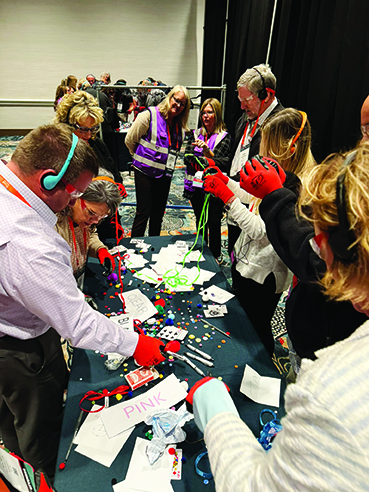 “Attendees were able to simulate some of the changes in things like hearing, vision, and mobility that people living with dementia experience. They had an opportunity to attempt complex tasks while navigating all the distractions and complications someone with dementia may encounter,” said Rogers. Program participants went home with new tools they can use to educate their own staff, families, and caregivers.
 “As empathetic and full of care as our teams are, it can be a struggle to overcome the challenges of caring for residents with dementia,” said Tina Sandri, MHSA, LNHA, president of Forest Hills of DC. “This program is designed to give people a deeper understanding of what their residents living with dementia feel and experience. Then they can go home with a tool kit and share their experiences with their staff.”
She added, “There are visual learners, tactile learners, and auditory learners. We do a lot of visual and auditory education at conferences, but we don’t do much tactile. This program brings another dimension of learning.”
Ensuring Innovative Infection Prevention and Control
Infection prevention and control is a top priority for long term care facilities. Specialized training in this area is key for infection preventionists (IPs) and other team members, as there is an ongoing need to work as a team to prevent the spread of infections. “When team members receive specialized training, they become champions and experts, and everyone benefits,” said Dan Schock, RN-BC, BSN, director of clinical services at Vetter Health Services, Inc.
Even experienced IPs or knowledgeable team members can benefit from ongoing training. There are always new infection strains, updated vaccine information and recommendations, and innovations in technology. As new information comes out, specialized training can keep IPs and others on the cutting edge.
AHCA/NCAL has an online Infection Preventionist Specialized Training (IPCO) program for IPs and others in nursing facilities. It consists of nine course modules and covers common pathogens, multidrug-resistant organisms, antibiotic stewardship, water management, and more. The program is flexible and self-paced, and participants have up to twelve months to complete it.
 Amy Miller, RAC-CT, CPC, director of clinical and regulatory services at AHCA/NCAL, said, “IPCO goes beyond the regulatory requirements on how to start and manage an infection-control program. There also is a leadership aspect that is different from other training programs.”
She stressed that the IP is an important member of the leadership team, but IPs can’t succeed alone. Organizational leaders should consider what other staff might benefit from participation in specialized training such as IPCO. Miller said, “The director of nursing, medical director, administrator, or others who have oversight of clinical programs or manage compliance and operations can benefit from such programs, which provide them with a broad view of what infection prevention and control looks like and how to assess and innovate what is happening in their facilities.”
As infection prevention and control evolves, it is important to identify programs that are based on the latest research and best practices. “IPCO is always being updated,” Miller said, “and we keep links and referrals to other sites current.” These sites provide current, additional resources to address such pertinent issues as safe water management and contamination risks. Additionally, IPCO recently created an offshoot program for assisted living communities, even though these facilities are not required to have an IP.
With the field’s evolution, specialized training in infection prevention and control can’t be one-and-done, especially for IPs. IPCO offers a renewal every three years that allows participants refresh their skills and knowledge, and the Centers for Disease Control and Prevention is always posting new information and updates.
Beyond Practice to Operations
While specialized training may focus on one topic, such as dementia care or infection control, it is important that team members understand the broader implications of their new knowledge and skills. Ciolek noted, “Having an external perspective can be very helpful to help staff realize the importance of what they do, to both their residents and the organization, in term of things like regulatory compliance and reimbursement.”
 Leah Klusch, RN, BSN, FACHCA, executive director of The Alliance Training Center, agreed, noting, “We have seen numerous regulatory changes in the last year that impact our operational processes for managing our facilities. We need to inform our staff about these changes and ensure that they understand the impact of these on their work and how they’re providing care for older adults.” She added, “We no longer can have just one person on our team with an understanding of the regulations and surveyor guidance because there is an interdisciplinary implication for everything we do.”
At the same time, Klusch noted, “CMS [Centers for Medicare & Medicaid Services] has introduced some new definitions, so our teams may need to change how they describe things. We need to make sure everyone is using the same definitions, and they need to understand that they may need to change how they describe or document something.”
When teams know what everyone else is doing, and they are communicating consistently, they can promptly connect the dots and identify issues such as condition changes or signs of illness or pain. In addition to training, Klusch suggested, it is useful to have resources handy at the nurses’ stations with the new terms and definitions from the updated Resident Assessment Instrument Manual.
Staff members are so busy with day-to-day care that training often gets put on the back burner. “We are all so busy that we sometimes diminish the amount of training times we provide our staff, but it has to be a priority,” Klusch said.
She stressed the need to ensure that team members get the information and training they need based on their responsibilities and style of learning. “Training isn’t one-size-fits-all, and we need to address differences in learning styles.”
Joanne Kaldy is a freelance writer and communications consultant based in New Orleans.
Read more: Creating-a-Training-Positive-Culture.aspx