 When seniors sign up for Medicare Advantage (MA) plans, they’re drawn to the promise of more comprehensive coverage at a lower cost. For a growing number of enrollees, however, their experience falls short of that promise. Some wait in the hospital for an authorization that takes days to come through; others are discharged from skilled nursing facilities (SNFs) before their doctors think they’re ready. They file appeal after appeal with their plan, not knowing if they’ll be cleared to stay and recover. Maybe they go home early, only to end up back at the hospital. Or maybe they pay out of pocket for care they thought their premiums were supposed to cover.
Meanwhile, the federal government pays handsomely for their experience. MA enrollment reached 35 million this year, constituting a little over half of the eligible population. A recent MedPAC analysis found that MA plans will cost the government 14 percent more than fee-for-service Medicare plans, or about $76 billion in payments to participating insurers. Provider spoke with a range of long term and post-acute care leaders to understand why so many patients aren’t seeing the benefits, and what can be done to give them the care they deserve.
Delays and Denials
For patients, the gap between MA’s promise and its reality is felt most potently in the prior authorization process. It’s a constant battle. In many cases, MA plans simply don’t recognize certain procedures, for example, IV administration or wound care, as skilled care and deny authorization accordingly. In addition, plans typically only approve SNF stays for a few days at a time, requiring providers to go through the whole process again—and again—for patients who need longer stays.
In some cases, the plan might need to be notified when the patient it authorized actually comes to the building; if it doesn’t receive that notification within 24 hours, it doesn’t pay. In other cases, they only approve the lowest level of acuity care they can justify, putting the patient at increased risk of re-hospitalization.
“You almost have to have a dedicated authorizations team” to navigate this labyrinth, said Caryn Miller, who handles billing at Elmbrook Management Company, which manages 13 facilities across rural Oklahoma. Part of the problem is the lack of any standardized system across the different plans: each plan has its own rules, procedures, portals, and timelines. “Humana has one set of rules; UnitedHealthcare (UHC) wants something else; Aetna has their own fee screen that doesn’t match what any other company does,” Miller said. “Even within an MA company’s umbrella, you’ve got so many different plans that you have to understand the rules and what each resident’s policy looks like.”

Patients face a grueling stream of delays or denials of authorization, often against clinical recommendations. In AHCA’s May 2025 survey of 363 nursing home providers, two-thirds reported that MA plans deny or delay post-acute care on a daily or weekly basis. A January 2026 study by Acentra Health looked specifically at MA-issued notices of Medicare non-coverage, finding that 92 percent of beneficiaries who received them still required skilled nursing or therapy services. The study also found that 72 percent were at risk for decline, injury, or readmission if discharged prematurely.
A 2024 Senate investigation into the three largest MA insurers corroborated the providers’ experiences, finding that the plans deny prior authorization requests for post-acute care at a higher rate than other forms of care. In 2022, per the Senate’s report, UnitedHealthcare and CVS issued denials for post-acute care at about three times their overall denial rates. Meanwhile, Humana’s post-acute denial rate was more than 16 times higher than its overall rate.
These factors inevitably impact patient care and recovery, sometimes requiring lengthy, unnecessary hospital stays while patients wait for approval for an SNF transfer, then early discharges from the SNF against medical advice. They have the right to appeal, of course, but the appeals process adds compounding stress for all parties. “We have probably an average of four appeals for each Advantage patient and as many as 14,” said the administrator of a five-star facility in the northeast, who requested anonymity to speak candidly. “Every two days the Advantage plans are issuing [Notice of Medicare Non-Coverage] (NOMNCs). Every two days, a patient is appealing. Every two days, Medicare is overturning that decision and saying, ‘No, they’re still skillable.’”
 Providers are reporting an increase in NOMNCs after the issue of prior authorizations was put under the microscope by federal policymakers. In June 2025, the Department of Health and Human Services (HHS) and the Centers for Medicare & Medicaid Services (CMS) announced a new pledge by insurers to streamline and improve the prior authorization process, and in April 2026, insurers announced that they had reduced prior authorizations by 11 percent. The result has been an uptick in frequent reauthorizations, suggesting a new strategy by MA insurers to maintain costs.
“That’s of course very stressful for the families, because every two days they’re not knowing if they’re going to have to take the patient home,” the administrator added. “They’re having to file appeal paperwork and wait to see what’s going to happen.” The uncertainty inherent to this process makes it difficult for providers to arrange the home care services a patient would need for a safe discharge. “We don’t have home care agencies just on standby in case somebody loses their appeal, and all of a sudden they’re having to leave in 48 hours.”
“It’s frustrating for families,” agreed Len Russ, Principal Partner of Bayberry Care Center in New York and co-chair of AHCA/NCAL’s Reimbursement Cabinet. “They have a direct dialogue with the provider and the caregivers onsite, but not the ones who are pulling the strings from somewhere else. It’s not the most user-friendly structure of care.”
The Magic Machine
In some cases, the ones pulling the strings aren’t exactly human. “They’re using algorithms to determine average length of stay based on the patient’s conditions, and they’re sending out prior authorizations with that amount of time or less,” said Maureen McCarthy, CEO of Celtic Consulting. “You have to have the ability to extend that for patients who would need more time, who have multiple comorbidities.”
 Susie Mix, CEO of Mix Solutions, put it a little more bluntly. “They submit the patient information into a little magic machine, and it spits out what we’re supposed to provide the patient and what reimbursement we should receive,” she said. “Unfortunately, that machine is not somebody looking at that patient and assessing them from head to toe.”
Also concerning to McCarthy is the way MA plans are using algorithms to identify providers with a record of successfully challenging denials. “There are also algorithms built to look at who’s appealing and who’s winning the appeals, and they’re no longer sending patients to those who are winning the appeal,” she said. She described a client who received a call from a plan challenging its 85 percent overturn rate—as if the provider was the party at fault. She had to reassure her client that this meant they were doing things right: “If they’re being overturned 85 percent of the time, they are the ones making the inappropriate decisions, not your facility.”
A 2023 investigation by Stat News attested to these providers’ experiences, describing the use of “unregulated predictive algorithms, under the guise of scientific rigor, to pinpoint the precise moment when they can plausibly cut off payment for an older patient’s treatment.” Doctors, medical directors, and administrators claim that the denials often target care that’s usually covered under traditional Medicare, though they often struggle to get satisfying explanations from the insurers.
“Some give up and go home before they’re clinically ready, risking readmission,” said the administrator of the facility in the northeast. “Others end up paying out of pocket for care their premiums were supposed to cover.”
When the Bill Comes Back
Even after care is approved and delivered, MA plans may still conduct an audit and end up refusing to pay—or even recouping the reimbursement they already paid. “We see numerous instances where they’ll do an audit and then they’ll take the money back after the fact,” said Russ. “Sometimes it’s just very technical—the right signatures and the order wasn’t put in the right place for the therapy, or the doctor didn’t sign the order. They can use a myriad of excuses to deny payment or claw back payments, while disregarding the patients’ positive outcomes.”
Although audits are a necessary, legitimate part of safeguarding system integrity, administrative burdens invariably lead to adverse consequences for patients. Providers who have been burned by clawbacks may become more cautious about which MA plans they’ll accept.
The administrator of the five-star provider in the northeast said that their facility sometimes has to refuse plans that don’t approve patients for the care durations they need, even if the facility has cared for the patient previously. “It’s very sad because they have a comfort level with us,” they said. “Oftentimes it’s a lovely family and a lovely patient with great potential for significant improvement and independence.” However, the administrator does not want to compromise on the level or length of care patients need, especially for those with medically complex conditions. Patients being discharged prematurely may have to be readmitted to the hospital, which is not desirable for the patient and impacts the SNF’s quality data, potentially leading to penalties.
While some facilities have the resources to navigate the maze of prior authorizations, reauthorizations, and appeals, others don’t. Smaller facilities may be less equipped to absorb clawbacks or train staff to adapt to new procedures. If they stop accepting certain MA plans, the nearest alternative for patients could be hours away. That’s why providers are calling for more transparency and accountability for these practices; the alternative is that patients, especially the most vulnerable ones, will lose access to the safe, timely, high-quality care they deserve.
How Providers Are Adapting
Providers across the country have found their own ways of making sure they have the tools to serve MA patients. At Cascadia Healthcare, which operates dozens of facilities across Idaho, Montana, Washington, Oregon, and Arizona, Chief Financial Officer Steve LaForte created a dedicated authorization team to handle approvals. “We have a managed care department and brought in a full-time director of managed care in 2021,” he said. “She’s now got a staff of, I think, five people dedicated to managed care, really proactively managing the sustainability of the relationships. They’ve gotten really good at it.”
 For the administrator of a five-star facility in the northeast, patient education is key to navigating managed care. As they explained, many people enroll in MA because they think they’ll get better, easier care than through traditional Medicare. They don’t know about the issues involved, which is why it’s so important for providers to give them the facts. It’s about education, not persuasion, as federal guidance stipulates that providers can aim to inform patients and families without influencing decision making or marketing specific plans.
“When a Medicare Advantage patient is admitted, we immediately begin educating them on the Medicare Advantage process,” the administrator said. “Patients and families are informed that the MA plan will be approving a 3- to 4-day stay and then they will receive a downgrade, at which time we may need to do an appeal. Families and patients are made aware they will need to be readily available to participate in their appeal.”
“During open enrollment, we open up to the public to receive education on what the Medicare Advantage plans cover and don’t cover,” they added. “Until you need the coverage, you likely would not know what is and isn’t covered.”
At Celtic Consulting, McCarthy encourages her clients to study the existing regulations so that they can leverage regulatory tools that already exist but which they may not know about. She pointed to the CMS appeals process, in which the first two levels involve desk reviews of paperwork but the third level involves an administrative judge. “It’s human to human, and you get to explain the circumstances of the case. That’s usually the best chance of winning,” she said. “I would encourage providers to get out to at least level three if they’re not successful at levels one and two.”
As for those first two levels? “Become familiar with what those regulations are, so you can use that language when you’re appealing to the insurance companies,” she said. She also pointed to a new CMS complaint form, which allows providers to submit complaints about MA plans. “We’re very excited that CMS came out with that earlier this year,” she said. “The problem is that not a lot of providers are aware of it just yet.”
Elmbrook’s Caryn Miller advised providers not to be afraid to seek help from their peers. “Reach out to other companies; ask how they’re doing it,” she said. “We’re all happy to share our information and our knowledge and take care of each other, because we need to.”
What Providers Want from Policymakers
In interviews for this article, providers stressed that MA plays a vital role in the health care ecosystem, offering patients lower costs, bundled benefits, and more coordinated care. As they discussed the pain points they experienced with managed care, they said that what they want most from policymakers are common-sense reforms that help MA live up to its promise.
One of the top priorities is standardization. “If MA companies are going to have rules outside of Medicare, then we need a standard set of rules for billing and authorizations with the managed care groups,” said Miller. “UHC can’t decide they want a 24-hour notice and not pay us. Humana can’t decide that they want to assign the assessment instead of accepting the facility MDS. I get it; maybe that’s the concept of outsourcing it to save money and protect the Medicare system, but at least standardize some of the rules.”
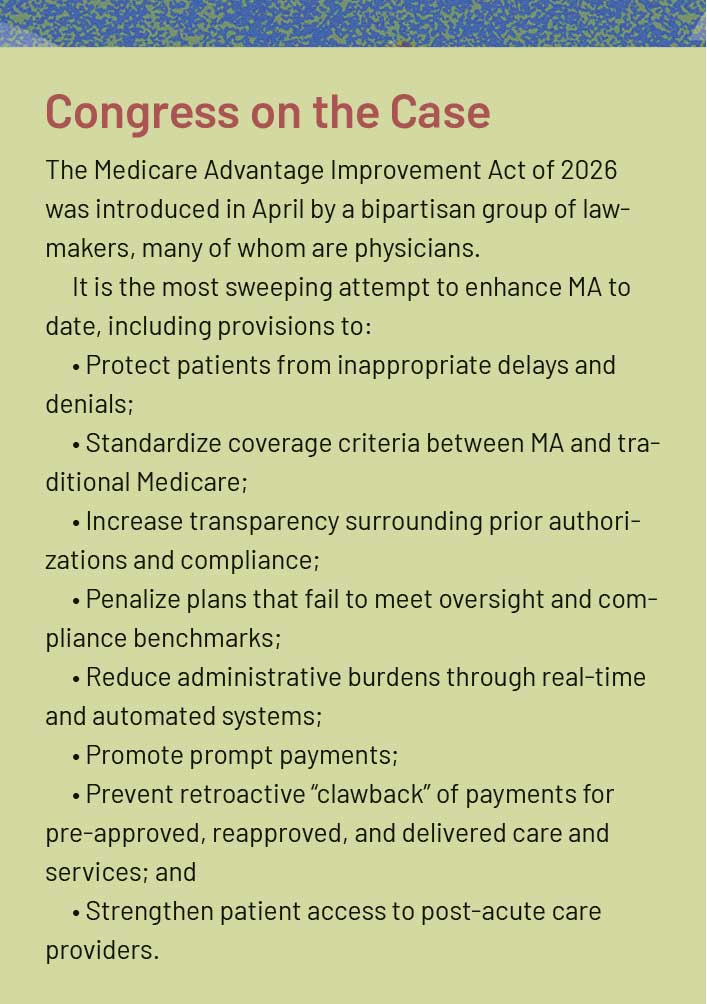
In addition to standardized authorization and appeals processes, providers hope for more reliable payment processes, no more retroactive denials, and enforcement mechanisms that keep MA plans accountable to the system’s promise—ideally with penalties for noncompliance. “CMS has done some fantastic things in creating certain guardrails and protections for beneficiaries, but it needs more teeth,” said McCarthy. “The plans need to be held accountable for not following the rules.”
“I’d hope to see some type of system where CMS is monitoring the percentage of overturns,” she added. “If you have an 85 percent overturn rate, you should not even be a Medicare Advantage provider anymore. You’re obviously not managing the benefits appropriately.”

Echoing McCarthy’s concern about accountability for plans with high overturn rates, the northeast facility’s administrator also proposed enhancing the MA Star Rating System to increase transparency for consumers and score plans more appropriately. “There should be some kind of published documentation about where the Medicare Advantage plans score in certain things—length of stay, appeals that are overturned, things like that,” they said. “The public has a right to know.”
“We call the Department of Insurance or whoever it is, and nobody’s going out to these health plans and monitoring this,” agreed Susie Mix. “The issue is that there is no accountability after a regulation is set. Ensuring that there is some arm of the regulation holding these folks accountable is critical to the success of the regulation.”
“Careening into a Crisis”
Whatever the solution may be, providers believe it’s essential for patients that regulators help chart a more practicable route forward. “Medicare Advantage has to work,” said LaForte. “We’re careening into a crisis unless we find a way to be more collaborative and more sustainable.”
In his view, the solution might look like a public-private partnership where the government has more effective means of holding MA plans accountable. “We need the government to create better accountability and more parity with fee-for-service Medicare,” he said. “There’s got to be an equitable middle ground there.”
Bayberry Care Center’s Len Russ agrees. “Medicare has been steadily increasing reimbursement to the plans, but the plans have not been passing it on to the providers they contract with—not even fractionally.”
He and many other providers say they have not seen an MA rate increase in more than a decade even though SNFs are seeing patients with higher levels of acuity with each passing year. Coupled with the significant resources providers have had to dedicate to the mountain of MA documentation requests, the popular coverage option could create significant financial strain for the post-acute sector.
Russ pointed to what he called a “paradox” at the heart of the issue, one which may eventually force the government’s hand: as patients get older, become more complex, and need more services, they’re increasingly disenrolling from MA and enrolling in traditional Medicare. “The government’s getting the worst of both worlds,” he said. “The companies are getting a lot of money and not having to deliver a lot of services for the healthier, younger, post-65 population. But then when they get older and sicker, they go to Part A—and that’s more expensive on the government’s end.”
 Through its Better Way policy agenda, the American Health Care Association has been elevating these MA issues to federal lawmakers, which have the attention of Republicans and Democrats. “We are really encouraged that members of Congress in both parties and in both chambers want to address these concerns with Medicare Advantage,” said Michael Bassett, AHCA Senior Vice President of Government Relations. With numerous bills being introduced, he is hopeful that meaningful legislation could be considered during the lame duck session at the end of the year. “Consensus in Congress is challenging, but we can all get behind ensuring our nation’s seniors have access to the benefits they have earned.”
Until policymakers step in, providers are doing what they can to work around administrative obstacles, appeal denials, educate patients and families, and help build a better path forward. “We have to keep our voices in the mix,” concluded LaForte. “We have to be as loud as possible.”
Steve Manning is a journalist based in New York City.