 |
Pictured in this article: Dwyer Scholars at graduation. (Photos courtesy of Dwyer Workforce Development)
|
The call came from one of Dwyer Workforce Development’s partners. One of its students, a Dwyer Scholar training to be a certified nursing assistant, was in trouble. She was juggling multiple jobs while her partner was waiting for some money to come in, and they were facing eviction. “This person is worth helping,” the training partner told Dwyer’s staff. “Let’s get her some help.”
Dwyer quickly cut a check, helping the scholar avoid eviction and continue with her training. “She’s now killing it,” said Barb Clapp, Dwyer’s president and chief executive officer.
Stories like this have left Clapp convinced that while the labor shortage is dire, it’s far from hopeless. A 2025 PHI report projects 9.7 million direct care job openings by 2034; Clapp’s team regularly meets people eager to fill those jobs.
“There is no shortage of people that want to work in healthcare,” she said, describing waiting lists full of applicants eager to participate in Dwyer’s program, which provides free training and comprehensive support to people pursuing a job in healthcare. What’s standing in the way are the systemic barriers that Dwyer helps them overcome.
‘Once a Dwyer Scholar, Always a Dwyer Scholar’
Clapp founded Dwyer in 2021 after selling the communications firm she ran for 18 years. When one of her former clients, Capital Funding Group owner Jack Dwyer, asked what she wanted to do next, she said she wanted to run a nonprofit. He told her he wanted to help people who lack opportunity and to fix the healthcare staffing shortage, and he tapped her to lead the nonprofit he created to do it.
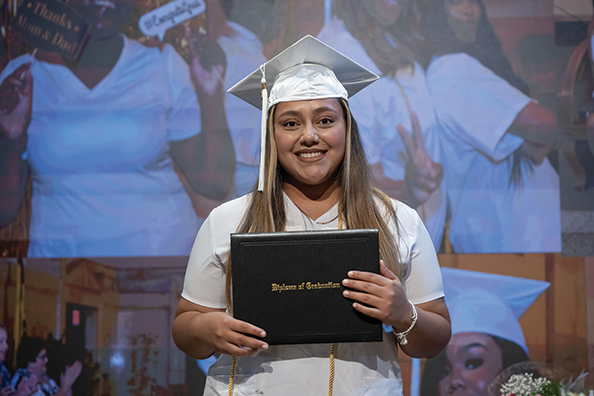 From its origins in 2021, when Clapp was the only employee, the organization has grown to more than 60 employees, having served more than 16,000 Dwyer Scholars across 11 states. Its goal is to reach 100,000 scholars by 2030.
For scholars, the program begins with an intake questionnaire that identifies the barriers applicants are facing and the support they need from Dwyer. An online resource hub directs them to services they can find in their own community, such as free or subsidized childcare, with Dwyer filling in the gaps. Dedicated case managers stick with scholars while they receive certified nursing assistant (CNA) training and after they enter the workforce.
For Clapp, the mission is more than just placing scholars with employers. “A lot of workforce programs follow people for 30 days or three months after they are trained,” she said. “I made up my mind: once a Dwyer Scholar, always a Dwyer Scholar.” If scholars want to seek additional credentials (and the earnings that follow), Dwyer helps them explore whatever route they’re interested in, from licensed practical nurse to surgical technician.
Clapp stressed that Dwyer’s support comes with expectations: For instance, it covers childcare until a scholar gets a job, after which the scholar takes over. “We aren’t trying to make people dependent on us,” she said. “We’re trying to make people independent.”
Still, that support is substantial. If Dwyer hears from a provider that a scholar has been struggling with timeliness, a case manager will get in touch and see what Dwyer can do to help. In many cases, the scholar might not have the experience to know that human resources (HR) should be informed about whatever they’re dealing with—say, car troubles. If that’s the case, Dwyer provides rideshare passes and helps get the car fixed. Thanks to these support services, Clapp said, Dwyer’s partner organizations enjoy 30 percent to 40 percent higher retention rates.
Caring for People
One of those partner organizations is Touchstone Communities, which operates skilled nursing facilities (SNFs), assisted living communities, and Texas State Veterans Homes. Jack Dwyer himself made the introduction, and Touchstone felt the fit was natural. “The mission of Dwyer is very consistent with our mission at Touchstone to make lives better,” said Leslie Cunningham Campbell, Touchstone’s chief operating officer.
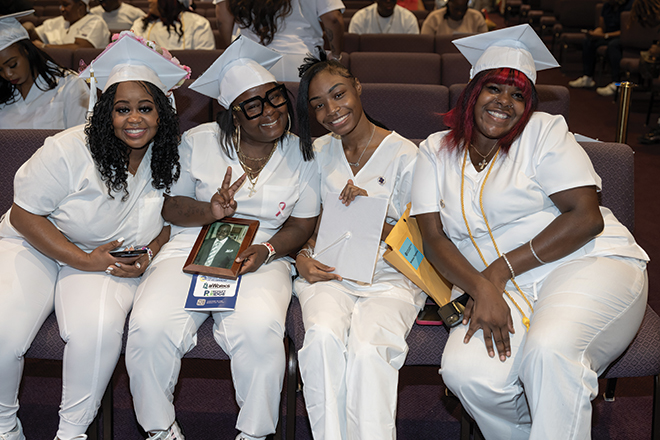 As part of that mission, Touchstone expects every leader within a community to know its scholars’ names and stories. New scholars are partnered with leadership mentors and peer mentors, who provide day-to-day support, and on-site HR partners who serve as assistant case managers alongside Dwyer’s own case managers. They take care to notice if a scholar is clocking in late or coming to work without a lunch, and they identify what the underlying issues might be—and how Touchstone can help. “Closest to the bedside is where the intimate details of that individual’s story is best understood,” Campbell observed.
That level of attention extends from the floor to the C-suite. Campbell gets on a call every week with Touchstone’s chief nurse, regional leaders, and Dwyer, where they all put their heads together and figure out how to best use their resources and wraparound services to support the scholars. “Operations drive action within the SNFs,” she said. “We haven’t relegated this as purely an HR matter.”
The partnership spurred Touchstone to go even further in its own efforts to support its employees, including by ensuring that food is available to whoever needs it. “Dwyer’s approach inspired us to expand our own outreach efforts to things like food and fellowship, where we have food available to the team during their shift,” said Melissa Brown, the provider’s vice president of sales and marketing. “We want to care about people who are caring for people.”
It’s a successful philosophy: Several of Touchstone’s scholars have already moved up to medication administration aide roles, and the company is committed to helping others achieve their long-term aspirations.
Partnering for Success
Dwyer has high expectations of its training partners, which include community colleges and private organizations. “You don’t train people and just say, ‘Off with you, good luck,’” Clapp said. Rather, partners are expected to shepherd scholars through licensure and testing, with Dwyer keeping track of pass rates. At a recent leadership breakfast, Clapp said, several partners told her that the scrutiny had encouraged them to up their game, ultimately improving their programs.
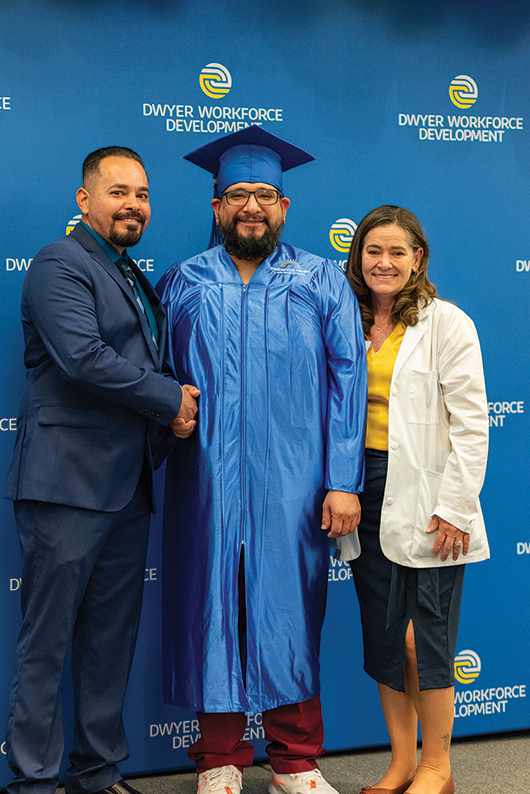 Lisa Chamness, Dwyer’s director of partnerships and programs—and the organization’s third employee—works with a team of state-level coordinators to build partnerships with trainers, employers, community organizations, workforce boards, and foundations. “We don’t partner with just anybody,” she said. “They have to have that same passion.”
Dana Ritchie, associate vice president of constituency services and workforce at the American Health Care Association/National Center for Assisted Living (AHCA/NCAL), said, “Dwyer Workforce Development is helping build the workforce our long term care communities need through investing in people, and AHCA/NCAL is proud to champion this program. By combining free training with practical support, Dwyer opens doors for aspiring caregivers and helps current employees advance. We’re spreading the word across our state affiliates and provider members and encouraging providers to explore what this partnership can do for their teams and individuals they serve.”
Support from AHCA/NCAL and its affiliates has opened doors in new states. In Florida, Dwyer presented to the workforce committee at the Florida Health Care Association (FHCA), and FHCA informed its member organizations about the program. When Eric McKinney, administrator of Royal Oaks Nursing and Rehab Center in Titusville, Florida, heard about the program from an HR rep at his parent company, Southern HealthCare Management, he saw particular value for his existing team members. There were many who wanted to advance internally, he said, but who couldn’t find local training programs that aligned with their shifts or budgets.
 One of the first to sign up was Terrann, a housekeeper. Dwyer set her up with one of its courses, which she passed quickly.
“They did exactly as they said they would,” McKinney said. “We got her on board here, and now she’s been working with us as a CNA for the last six months, give or take. She’s been doing great.”
Asked what he would tell a provider considering partnering with Dwyer, he said not to overlook its value for people like Terrann. “Have a good pulse on who in your center would be a good candidate,” he said. “We looked at it as a way to encourage our own people to get involved.”
At Touchstone Communities, Campbell was similarly enthusiastic. “Don’t hesitate,” she said, citing Clapp’s informal slogan for the nonprofit: “Better together.”
“When the operator’s in line with Dwyer,” Campbell concluded, “wonderful things happen.”
Steve Manning is a journalist based in New York City.