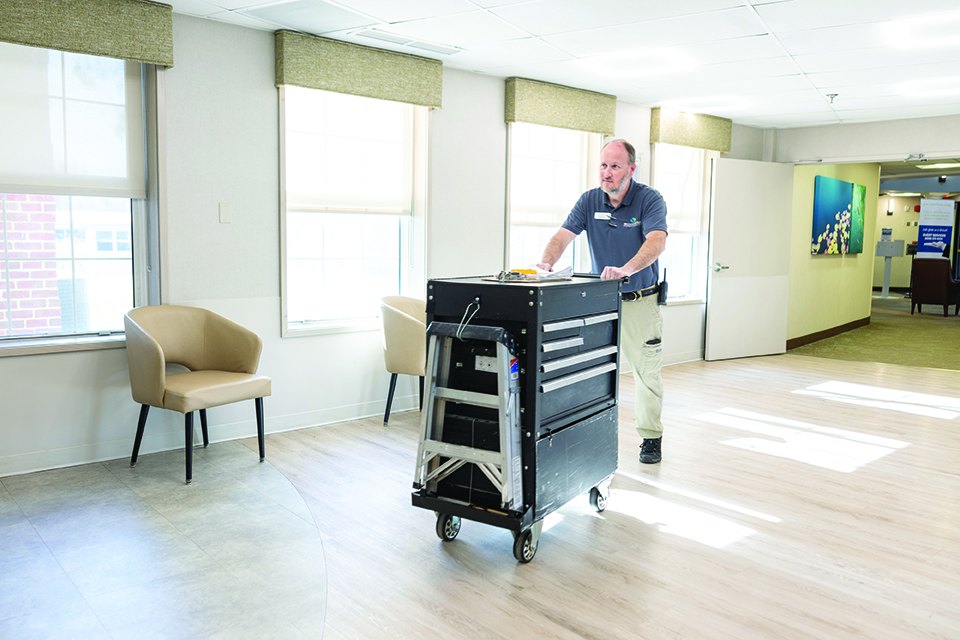
 Like other team leaders, maintenance directors and facility managers benefit from training and education to enable them to fulfill their roles effectively, identify opportunities for change and improvement, and sharpen their skills and competencies. To provide this education and training, the American Health Care Association/National Center for Assisted Living (AHCA/NCAL) developed a Maintenance Director Training Course, which is structured into seven focused modules, each addressing critical areas of facility safety and compliance:
- Maintenance Director Overview
- Fire and Smoke Door Inspection
- Generator Inspection, Testing, and Maintenance
- Portable Patient-Care Related Electrical Equipment (PCREE) Testing
- Kitchen Fire Safety & Compliance
- Oxygen Cylinder Storage
- Sprinkler System Inspection, Testing, and Maintenance
Each module is brief (about 10-20 minutes) and includes educational videos, downloadable presentations, and handouts to support learning and implementation.
Upon successful completion, participants receive a certificate that can be used to demonstrate competency in fire and smoke door inspections, fulfilling annual requirements under NFPA 80 and NFPA 105, as part of the 2012 Life Safety Code®.
This course is intended for those who are new to their facility maintenance role, focusing on life safety and emergency preparedness compliance. However, experienced maintenance directors, administrators, and other facility leaders can benefit from learning about what to expect from and how they can support their maintenance director.
The course offers guidance on how to prepare for a survey and focuses on some of the most commonly cited survey issues and tags. It offers tips on how to best remediate these issues prior to a survey and stay in compliance over time.
Hood observed, “This course requires just a short investment of time, and it’s free for AHCA/NCAL members. In return, you get practical information about and work toward a successful life safety survey.” Meghan Medvitz, MSHS, Director of Quality Improvement and Emergency Preparedness at AHCA, noted that the course could help facility maintenance programs function more seamlessly when there may be turnover or new maintenance directors that come in with limited experience in long term care. Not only will participants learn about life safety survey issues, but they will also get practical guidance on safety and life-saving issues, such as fire and smoke door inspections, generator maintenance, and kitchen fire safety.
“We started with four modules and now have seven. This is a growing course, and we are continually looking at additional topics that might be useful for participants,” said Medvitz. She stressed that the course is a great resource not only for maintenance directors but also for administrators and corporate staff who oversee maintenance. “There’s a real value to organizations having a wider awareness of how maintenance protects residents, staff, visitors, and volunteers and helps ensure regulatory compliance,” she offered.
Online participation is available all year long. For more information or to register for the course, go to ahcancalED.