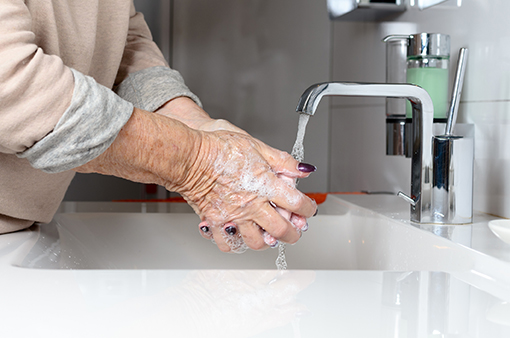
When families tour a senior living community, one question matters more than any other: Will my loved one be safe here?
Safety is not only about caregivers and clinical services. The building itself is part of the care environment, and few systems affect residents as directly as plumbing. The sink where a resident washes their hands and the shower where they begin the day are points of use where infection, scalding, falls, and other avoidable harm can either be prevented or enabled.
For senior living operators, the goal is more than maintaining code-compliant plumbing. It is applying a health care risk-management mindset to water systems: identify hazards, establish controls, monitor performance, correct deviations, and document the results. Plumbing becomes part of how a community supports infection prevention, resident independence, safety, and survey readiness. The Centers for Disease Control (CDC) identifies
water-management programs as a primary strategy for reducing the risk of Legionella growth and spread in building water systems.
1. Make water management a compliance and quality responsibility.
Water management should not be treated as a facilities responsibility alone. In senior living, it belongs within the infection prevention and control program, alongside hand hygiene, environmental cleaning, staff education, and quality improvement.
A strong program brings together infection prevention, facilities, nursing, environmental services, and administration. This group should identify water-related hazards, define control measures, assign ownership, establish monitoring points, record corrective actions, and review performance regularly.
At Centers for Medicare & Medicaid Services (CMS)-certified nursing homes, water-management policies and procedures addressing Legionella and other opportunistic waterborne pathogens are a requirement (CMS memo QSO-17-30), and surveyors review them under infection control (F880). For all senior living communities, the practical standard should be the same: if a surveyor asks how the community manages water-related risk, leadership should be able to show a current, active program, not simply describe one.
ASHRAE Standard 188 offers a useful framework. It establishes minimum requirements for legionellosis risk management, including a building survey, development of a water-management program, preventive measures, and supporting documentation It also includes specific requirements for health care facilities.
Start by establishing a water-management team and maintaining a written program that identifies risks, control measures, monitoring methods, acceptable operating ranges, corrective actions, and an annual review process.
2. Assess risk where residents interact with water.
Before replacing fittings or upgrading systems, walk the building. Review resident rooms, common restrooms, therapy spaces, memory care neighborhoods, bathing areas, vacant apartments, and low-use areas.
At every sink and shower, consider:
-
Accessibility: Can a resident with arthritis, reduced grip strength, or limited mobility operate the faucet or shower independently?
-
Temperature control: Is water delivered at a safe outlet temperature for residents who may have reduced sensation, slower reaction times, or fragile skin? Confirm the range that applies to your community.
-
Stagnation: Are vacant rooms, guest suites, or little-used bathrooms allowing water to sit in pipes, valves, or hoses?
-
Shower design: Do hoses, valves, and supply components drain effectively after use?
-
Behavioral-health safety: In memory care or behavioral-health environments, could faucet and shower design create avoidable ligature risks?
Document the findings. A risk assessment should drive fitting specifications, maintenance priorities, flushing schedules, and staff responsibilities.
- Sensor-operated faucets for resident and common-area sinks, paired with automated hygiene flushing
| - Automated, programmable hygiene flushing for low-use outlets, with recorded flush dates, times, and durations
|
- ASSE 1070-compliant point-of-use temperature limiting at faucets
| - Remote connectivity for faucet status, temperature verification, hygiene-flush scheduling, alerts, and maintenance documentation
|
- ASSE 1016-compliant thermostatic or pressure-balancing shower valves, with an adjustable maximum-temperature limit stop
| - Laminar-flow outlets to reduce splash and aerosolization
|
- Outlet-temperature monitoring with time-stamped data capture and alerts for readings outside the facility’s established range
| - Ligature-resistant faucet and shower profiles where risk assessments indicate a need
|
- Self-draining shower systems, supply lines, and hoses
| - Serviceable components and clear access for inspection, battery replacement, calibration, and maintenance
|
3. Specify fittings that address care risks.
Once risks are documented, specify fittings that support infection prevention, resident safety, and compliance objectives.
-
Cross-contamination at sinks: Sensor-operated faucets reduce reliance on handles that may be touched with soiled hands. They can also support residents with limited dexterity.
-
Scald prevention:ASSE 1070-compliant temperature-limiting devices at faucets and ASSE 1016-compliant shower valves help maintain safer outlet temperatures despite pressure or temperature changes.
-
Stagnation and microbial growth: Automated hygiene flushing can help manage low-use outlets. Self-draining shower systems can reduce standing water in hoses, valves, and supply lines.
-
Splash control: Laminar-flow outlets can reduce splash and aerosols at the sink and support cleaner handwashing areas.
-
Self-harm prevention: Ligature-resistant faucets and shower systems may be appropriate in areas where a behavioral-health or memory-care risk assessment identifies a need.
The key is to include these requirements in project specifications rather than treating them as optional product features.
4. Operate the system as a resident-safety control.
Installation is only the beginning. A fitting’s protective features depend on disciplined daily operations.
Verify water temperatures at representative outlets and recalibrate or replace mixing valves when readings drift. Include low-use fittings in a documented flushing schedule, particularly in vacant units and infrequently used common spaces. Fold sensors, batteries, drain-down functions, flush cycles, and temperature-control components into preventive-maintenance routines.
Staff education matters as much as equipment. Care and facilities teams should understand that hot water running below its expected system temperature, an unused shower, or a failed sensor is not only a maintenance issue; it can also represent an infection-prevention and resident-safety concern.
5. Be ready to show, not just tell.
Compliance depends on traceability. The community should be able to connect each identified risk, such as a low-use shower, a temperature-control device, or a high-vulnerability resident area, to a defined control measure, a monitoring record, and a documented response when conditions fall outside the acceptable range.
Maintain a survey-ready file, digital or physical, containing:
- The water-management risk assessment
- Water-system diagrams and outlet inventories
- Temperature-monitoring and flushing logs
- Preventive-maintenance records
- Corrective-action documentation
- Staff-training records
- Evidence of routine program review
ASHRAE Standard 514, Risk Management for Building Water Systems, emphasizes systematic monitoring, corrective actions, and confirmation of program effectiveness, while also recognizing that older adults are particularly susceptible to scald injuries and microbial water hazards.
The most revealing survey question may be what happened when a control failed. A risk assessment and monitoring log show that the community has a plan and collects data. Corrective-action records demonstrate that the plan works in practice: staff identified an out-of-range condition, followed a defined response, documented the action, and verified that the system returned to its acceptable operating range.
This is where automation can strengthen compliance. Connected plumbing systems can automate scheduled hygiene flushing at low-use fittings, monitor and record outlet temperatures, issue alerts when a condition falls outside an established range, and create a time-stamped record for maintenance follow-up. Instead of relying solely on manual rounds and paper logs, teams can focus on responding to exceptions and confirming that corrective action was completed.
Automation does not replace the water-management team or its judgment. It provides more consistent evidence that required controls particularly temperature verification and flushing were performed, reviewed, and addressed when needed.
The Payoff
The strongest water-management programs protect residents and help leadership demonstrate due diligence. They make plumbing risks visible, assign ownership, and create records that support continuous improvement as well as regulatory review.
A safer water system does not necessarily require a new building. It requires a thoughtful assessment, equipment selected for the risks present, clear operating procedures, and documentation that proves the program is working.
 When plumbing fixtures are specified, installed, operated, and documented with intent, they extend the safety, dignity, and infection-prevention work that caregivers provide every day.
Greg Hunt is product manager for
Chicago Faucet's line of commercial products. He’s a certified ASSE 12080 Legionella Water Safety and Management Specialist and a member of the American Society for Health Care Engineering.
Provider magazine includes information from a variety of sources, such as contributing experts. The views expressed by external contributors do not necessarily reflect the views of Provider magazine and AHCA/NCAL. Learn how to submit an article.